|
~ Carny Lingo ~ |
This is Page J-P
Continue to Carnival Slang pages: A - C D - I J - P Q - Z
American Circus Slang British/Euro Circus Slang
Vaudeville SlangCiazarn & The Carny Code Gypsies Slang Main Index Website Top Page
Visit "Ballycast," my new podcast - click on the banner to open it in a new page
Find an error? Please report it to me. Here's an EMAIL LINK
This is Page J-P
Continue to Carnival Slang pages: A - C D - I J - P Q - Z
Jackpots — Troupers’ tall tales (regular folks might say "war stories") of their former exploits. "Cutting up jackpots" is the expression given to swapping these stories.
Jake — One of the stock medicine show characters: a comic blackface character.
Jam — A small-time confidence game, or high-pressure selling by pitchmen.
Jam Auction, Jam Pitch or Jam Joint — A scam in which giveaways of merchandise are used to excite and confuse the audience into purchasing inferior goods at inflated prices. The technique involves giving away small but useful items to everyone at the beginning, under the pretense that the auctioneer is distributing valuable merchandise as an advertising promotion by the manufacturer. Then the agent exacts a token payment, just pennies, for other items, and then he alternates giveaways of slightly more valuable items with sales of them for almost nothing, confusing the marks as to whether, at any given time, they are putting up money "as a good faith gesture" that they will get back, or whether they are tendering payment. When the audience is thoroughly confused, the agents add a final wrinkle: the sale of almost worthless (but apparently valuable) merchandise for what seem like "bargain" prices. (A much more detailed description is contained in my ON THE MIDWAY e-book)
Jenny — A merry-go-round.
Jig Show — Black girl show, from "jigaboo", a very uncouth epithet for black people.
John Robinson — To give an abbreviated performance, or to set all the tops on the back end end-to-end to increase the midway's apparent size.
Joing — To "jo" a game is to rig it so that it cannot be won.
Joint (sometimes "store") — Any carnival midway concession booth. Described by their layout for placement purposes: line-up joints fit with others in a row, center joints attract customers to all four sides and need to be in the middle of an open area. You could have a stick joint (built of wood and situated on the ground) or a trailer joint.
Jointee or Jointy — An agent, a person working a game. There is a firm social division between jointees and showmen.
Juice — Another term for bribes paid to local police.
Juice Man — The carnival electrician and operator of huge generators that can fill an entire 18-wheeler. Collects fees from each operator for "cut in" to the power supply.
Jump — The move to the next engagement.
Junction Box — Wooden boxes protecting connections between electrical cables, set at various points around the midway. The show electrician uses the wires and plugs inside these boxes to "cut in" each ride or concession, supplying power from the generator.
(to) Jungle Up — In its mainstream meaning, to camp out for the evening in a squatter's camp (a "hobo jungle"). In the early carnival, it meant to dine by stewing, in a communal pot, whatever might be contributed by the assembled men. (Also the origin of the mainstream term "pot luck").
Kayfabe — A wrestling term originating on the carnival lot. Inside information about the business, not to be disclosed to the public — "the straight dope." Sometimes used as a signal to stop talking too frankly because outsiders, or the authorities, might overhear: "Kayfabe, guys! Have you met my good friend Officer Jones?" To let something slip out because you just won't shut your mouth is to "break kayfabe." To "kayfabe someone" is to withhold information from them.
KB — When an operator has to give a disgruntled and complaining customer his money back.
Keister — A portable display case for the pitchman's wares. You set up you keister on top of your (tripes/tripe): a small tabletop supported by 3 wooden legs configured as a collapsible tripod. Later, and in modern day recreations, a light collapsible waiters' table serves the purpose. Also used to refer to a circus wardrobe trunk, or any luggage.
Key Girl — A swindle in which an agent sells keys to the room of a woman working in the carnival to players who believe she will dispense sexual favors. The foolish victims might find anything from an empty room (the carnival having moved out while the victim went for his "reward’). In a variation more commonly known as a "badger game", the girl’s angry "boyfriend" shakes the victim down for more money under threat of violence or exposure.
Key to the Midway — One of many pranks to play on "green help". In this case, a non-existent thing that you might send your victim off to locate for you. "Hey, kid, you seem like a smart fellow, so go down to the other end of the lot, find Big Sam, and get the key to the midway for me." Or "lightbulb grease" or a "left-handed monkey wrench" or a "board stretcher," maybe some "red lightbulb paint." Maybe send them somewhere to see if they have a "long weight." You might send them looking for the donniker foreman, or send them to a specific carny just to bug that guy, too.
Kick — The pocket (or wherever) a carny keeps his personal money.
Kick Stock — See "throw stock".
Kid Show — Circus term for a sideshow.
Knife Rack — A game in which knives are won by throwing a hoop over the knife and the (deceptively shaped) block the knife is sticking vertically in. Game is also played with watches as prizes, or by mounting the prizes on soup cans. See "Hoop-La".
Kootch Show — The raunchy version of the "girl show". No revue, no "posing," and definitely no clothes, just a close-up view of what men want to see. According to stripper Ann Groff, quoted in Lewis' Carnival, "Only a few peddle their asses. A girl has to be pretty hungry or pretty drunk to lay a mark … it just isn't done."
Larry — Describes something broken or damaged, be it merchandise or anything worn out, or even a person who's a loser (however affable) - "He's just a larry."
Lay Bear — "Well hey, little darlin', you wanna win one of these big bears? Come on, you get five balls to knock these milk bottles off the shelf, you can do it … wait a minute, you know, we're closing now, but there's one of these bears I got put away special for you in my trailer, would you like to see it? You would? Just come with me … how old did you say you was? Fifteen … I mean, you said 18, right? You're just gonna love this bear … is that your sister? She can come too, I might just have two bears…"
Laying Dead — When you have no booking for your joint, ride or show at some point during the season.
Laying it Down — When the agent describes how the game is played.
(Game) Layout or Laydown — The marked place on a joint’s counter where the mark puts his money to indicate his bet, or the "target" table the mark's coin lands on as he tries to win, or the chart that shows odds, payouts, etc.
(Carnival) Layout — The layout of the typical full-featured carnival was a time-tested pattern designed to draw crowds all the way through the lot and maximize their spending. The carnival was always laid out in the shape of a horseshoe. The crowd would enter the gate, and by natural instinct would proceed up the right leg. Games were the first joints they would encounter along the right leg of the horseshoe, games on the outside and rides on the center. The carousel was always the first ride beyond the front gate. After the games the crowd would find the shows and the the penny arcade. In the corner at the right hand bend of the horseshoe the big girl show would draw crowds that far. Across the back of the horseshoe would be the major rides, including one or more ferris wheels. In the far left corner would be the "jig show" (black girl show). Then along the left leg of the horseshoe-shaped map, other shows and then sales joints and games all the way to the front gate.
Layout Man — See "Lot Man."
Layout Pin — Stake used by the lot manager (sometimes called the "layout man") to mark where your joint is supposed to go on the lot. You may desperately want to move one of these while the lot manager's not looking … but if you do, the lot manager's going to take that stake and whack you upside your head.
Lecture Store — A storefront rented temporarily by a pitchman.
Lecturer — An individual who talks inside the show, lecturing on the various acts. Often, acts (especially human oddities) lecture on themselves.
Left Hand Side — In relation to the entrance or main ticket booth, the left side is considered a poorer location for concessions than the right side. Most people tend to enter and turn to their right, and many have spent all their money when they come around to the left hand side. Newcomers to the amusement business and people who don't make the lot man happy end up on the left hand side.
Light Plant — The "genny," the huge 18-wheel-trailer containing massive diesel-powered generators supplying electricity to the lot. Notorious for being an added expense ("ding") charged to carnies along with their rent, even more notorious for being shut down immediately when the lot closes for the night, leaving tired carnies to trudge back to their trailers in the dark.
Lineup — The row of concessions side-by-side along the side of the midway.
Line-up Joint — A joint in a row of joints, as opposed to a "center joint" in the central axis of the carnival, or "four-way joint" that stands alone and can attract business on all four sides.
Lobster Man — Human oddity with any of what are now called "limb reduction disorders," a birth defect giving their arms and/or legs the appearance of a lobster's claws.
Loc (or 'loke') — Your location on the lot. A loc near the major rides or on the right-hand side is usually pretty good, but a loc near the kiddie rides is a less favorable position.
Lookie-Lou — More a regionalism than strictly a carny term. Same as "lot lice," they'll walk around and see what they can see, but they won't part with a dime.
"Losum Game" — Some cite this as a a carny term for a game play that should be aborted. However, it is almost certainly a misunderstanding of the German or Yiddish “lies ihn gehen” pronounced "loz im gain," meaning "let him go." If a carny knows that further playing of a particular mark will present a problem, he will tell his co-worker "loz im gain" instead of saying "You're fleecing the sheriff's son, you idiot, now cut it out!" The agent needs to end the game and possibly refund the mark's money rather than find out what the consequences might have been. You can see the phrase "in action" (though not in a carnival context) in a scene featuring Mel Brooks as an indian in "Blazing Saddles." My source says "I remember an old flattie who was playing a mark and the head of the store told him to "loz im gain". The mark, probably Jewish and thus knowing the term, replied "Hell, why didn't you say 'lies ihn gehen' 40 bucks ago?"
Lot — The show grounds.
Lot Call — Lot Call is the time you are expected to show up on the lot each morning (usually after working until midnight). Ride operators use this time clean and maintain the rides and to meet with local ride inspectors, concessionaires bring in supplies, and everyone else has their duties to perform.
Lot Lice — Locals who arrive early to gawk and stay late to browse but don't spend anything.
Lot Lizard — A prostitute who works truck stops or rest-area parking lots. Not terribly important on the show grounds, but fairly familiar between stands.
Lot Man, or Lot Manager, Lot Marker or Layout Man — The guy you need to be very nice to, and pay (sometimes as much as 10% of your gross) because he decides where your joint is placed on the lot. Can make thousands of dollars in one large engagement like a State Fair. Pay him well and stay on his good side and you get a good location; cross him and you won't make a dime.
Low Pitch — A sales pitch delivered from ground level, or from not much more than an apple box to stand on.
Lugen — An unbelievably dumb, easy mark.
Major Ride — A medium-size ride like a merry-go-round. The largest rides are the "spectacular" rides.
Mark — A townsperson you believe to be a conspicuously easy victim. The ticket booth would have a high counter, above the average person's eyesight, and when the ticket-seller spotted a towny with a big bankroll he might short-change the customer, leaving the change on the counter. If the customer didn't notice or didn't count his change, the ticket-seller would lean over to give him some "friendly" advice about the best attractions, putting his hand on the customer's shoulder to point him toward a show he simply must see, simultaneously dusting his back with chalk from a hidden supply. If the customer instead complained about the wrong change, the ticket seller could always push the remaining change to him and say "I told you to take it." And what does an agent do when he spots a mark? He "plays" him - that's right, just like you play a hooked fish. But a carny truism is, "Always leave the mark a dollar for gas." With gas money he can go home (you don't want him stuck there to raise a beef).
Marker Stake — The lot man places marker stakes to define your joint's space on the lot. Get caught moving one and you might get hit with one.
Mender — A patch or lawyer who travels with the carnival.
Mentalist — Magician, often working with an assistant, whose act consists of 'reading the minds' of the patrons.
Merchandise Wheel — See “Country Store Wheel” and “Ham and Bacon Wheel”.
Merry-Go-Round — Carousel (q.v.)
Michigan Bankroll — A bankroll with a few genuine dollar bills on the outside, but just blank paper on the inside. Or a bankroll with a high note outside covering many $1 bills inside.
Midway — There's no "midway" on a carnival, it's all a giant midway. A carnival is really just a midway without an accompanying circus. The term "midway" comes from the "Midway Plaisance", the name of the amusement area at the 1893 World's Columbian Exposition in Chicago. That area was a mix of amusements, games and foreign pavilions showcasing (much like sideshows) "exotic" cultures with their "odd and funny ways". When games and sideshows were attached to a circus, the midway was the amusement area between the main ticket booth and the entrance to the big top, literally "midway" between the two. You would often hear sideshow ballys claiming that "the big show [circus] doesn't start for 45 minutes, there's plenty of time to see this entire exhibit."
 Military
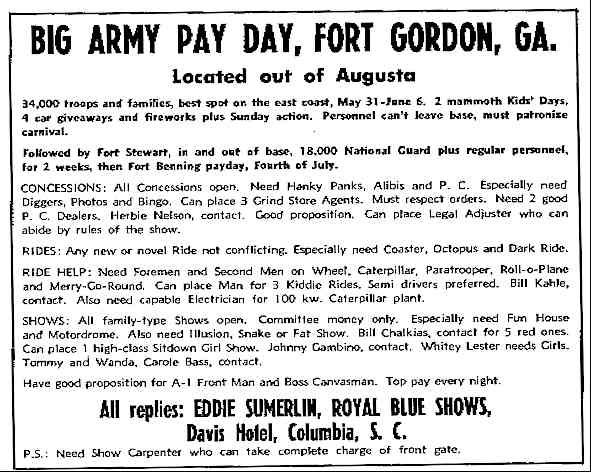
Payday — Oh, lordy, everybody's gonna get well today! Payday at a big military
base: just think of all those lonely men with all that money in their pockets!
"Step right up, boys, the first ball's free and the girl show's right over
there! You look like a healthy young man, private … these girls can do things
they just don't do back in Missouri! You think you're a good shot, soldier?
Try to shoot the red star entirely off this little card!"
Military
Payday — Oh, lordy, everybody's gonna get well today! Payday at a big military
base: just think of all those lonely men with all that money in their pockets!
"Step right up, boys, the first ball's free and the girl show's right over
there! You look like a healthy young man, private … these girls can do things
they just don't do back in Missouri! You think you're a good shot, soldier?
Try to shoot the red star entirely off this little card!"
Mirror Maze — A walk-through attraction consisting of angled mirrors alternating with clear glass panels and open spaces, it's fun to try to find your way through.
Missing Link — A person, ape-like in appearance (either faked or real), supposedly the legendary "missing evolutionary link" between prehistoric and modern man.
Mitt Camp — A fortune telling booth (from "mitt," slang for "hand," read by a palmist.) Being alone with a fortune-teller makes a number of scams possible, from "Your money is cursed, wrap it in this cloth so I can bless it" (you'll never see it again) to "My daughter say he touch her breast, she just 14."
Money Store — A game that pays off with cash instead of prizes.
Monkey Girl or Boy — Human oddity afflicted with hirsutism. Such individuals might also be called Wolf Boys, Dog Boys, etc. The amount of excess hair might be as little as a moderate beard on a woman, or a coat of hair as thick all over the body as it is on the normal person's scalp.
Mooch — An especially easy mark.
Motordrome — Generally billed as "The Wall of Death" or "Thrill Arena", this is a daredevil show in which motorcycles race around inside a cylindrical enclosure, driving up the side of the cylinder's vertical wall by means of centrifugal force and good traction. The performance progresses from simply driving around the wall, then adds stunts like having a second rider standing unsupported behind the driver. Early versions used small racing cars, and variations have included spherical cages used as tracks, driving with a lion in a sidecar, or having monkeys drive.
Mug Board — The painted board with a head-high hole that you stick your face through to get your picture taken at a mug joint, making you look like you're in a funny setting.
Mug Joint — Photographer offering quick-developed portraits, in the old days usually 1.5"x2" or 2.5"x3.5". Carried a selection of "mug boards" (see above) and novelty mounts (like funny postcards to insert the small picture into). Automatic cameras with a developing mechanism inside were offered to showmen in "Amusement Business"
Mugger — Operator of a "mug joint".
Museum Show ("Still Show") — A show in which the exhibits are not alive. The show might contain preserved, stuffed, or mummified freak animals, or other exotic items of interest like the weapons or cars used by famous murderers. A very easy grind show to work, it could still be truthfully billed with the claim "$1,000 reward if not absolutely real — please do not touch or feed the animals on exhibit". A banner or talker might promise "the world's most bizarre freaks past and present" referring to photographs or mannequins of the freaks.
Nail Store — The object of this game is to drive a nail all the way up to its head into a thick board with a single stroke of the hammer. It appeals to "he-men" and "do-it-yourself experts," but it can easily be gaffed. The agent has regular nails in one pocket of his apron to demonstrate, and in the other pocket he has nails weakened so that they will bend instead of driving true. But it requires good "people skills," because you don't want an angry mark with a hammer in his hand at your store, either.
Nanty — Nothing. (Compare the British circus use.)
Nelson — A nelson (or "full nelson") is a full day's work on the lot, to be paid in cash at the end. Watch out for a "red light job" when you go to collect your pay! (I have not been told whether there is a "half nelson," a half-day's work also known as a "quickie.") Both versions derive from the name of a wrestling hold.
Nautch Show — A girl show with particularly raunchy acts. From "nautch," the word for a professional dancing girl in India.
New — Carnies are hard workers whose job is often hazardous. They value experienced and trustworthy co-workers. "New" is an accusation of inexperience or poor judgement in instances where a carnival worker should know better, with the insulter asking "What are you, new?"
Notch Joint — (probably from 'nautch') After hours, an empty wagon or joint may be a temporary place of business where local prostitutes with extra energy service carnies with extra cash.
Novelty Act — Wrestling term, a "freakish" performer hired to appear in wrestling events as a special attraction. Might be a giant wrestler, midget, "hillbilly," hairy beast, grotesque or deformed person, or a trained animal (such as "Man vs. Chimpanzee" matches).
Nudist Colony — A sideshow attraction that enjoyed considerable popularity over the years. The prospect of seeing naked flesh was a strong lure, but the show on the inside featured girls in skin-colored tights.
Nut — The "overhead," or operating expenses of a show or a joint (still used in the movie theater business as "the house nut"). Supposedly from the idea of creditors removing the nuts from wagon wheels and not returning them until paid. A show always seeks to 'make the nut' and begin making a profit above expenses. A show that hadn't yet 'made the nut' was said to be 'on the nut' and one that had was said to be 'off the nut'. It was good if you could count on your show to always 'carry the nut.' Also "burr".
Nut Mob — Three-shell (shell and pea) game and its associated shills and confederates.
(to) Oach — To skim money from your boss, like a jointee pocketing a few of the many dollars that come in over the course of the night. This, both in common parlance and on the lot, would be "holding out", but carnies abbreviate it to "H.O." and through heaven knows what process, "oach" or "oaching." Some sources read this as "oats", defining such horse fodder as the money that is held back ("I put a few oats aside.") Isn't a living language full of surprises?
Octopus — A flat store set up as a center joint: four counters, each with an agent (four man trap), called an octopus because it has eight arms (four men) to grab money with.
Office — The administrative office wagon. Also used as a signal that a confidence game is in progress and you'd better not say anything to queer the operation or clue the mark to his peril.
Office Joint or Office Ride — A ride or concession owned and operated by the show management, rather than by an independent.
"On The Lot And In The Air" — "I have arrived at the lot, the attraction is set up, and we are ready to begin serving customers."
Open Front Show — A show arranged so that the entire front of the tent is open, prompting passersby to look in, but the attraction in the center of the is hidden from sight except from within the tent.
Opening — See "bally"
Orders — Restrictions set on the operators by the carnival owner, allowing or disallowing the girl show to work hard, or games to cheat.
Outcount — In an add-up game, to count faster than the mark can count up his score, letting you count inaccurately (either to send him away too confused to see that he won, or to count in his favor to induce him to stay so you can build him up.)
Outdoor Amusement Business Association — The largest trade association for the carnival industry, with almost 500 member carnivals.
Outside Man — A shill used to promote a game by making bets to raise the payoff. Alternately, may be the innocent-looking crowd member who secretly operates the device that rigs the game.
Overcall — To call marks when they are in someone else's frontage, considered unethical unless you have established eye contact with the mark.
P.C. — A "percentage game", a gambling game like a "Wheel of Fortune" in which the odds can be depended on to deliver most of the money to the house. In this case, there is no "gimmick" or rigged play.
P.O.P. — "Pay one price," the admission plan allowing the customer to ride all he wishes and see every show for a single admission fee. Not good financially for show operators.
Pan Lamp, Pan Torch (less frequently "Banjo Lamp") — Antique system of area lighting. Works on the same principle as a miner's "carbide lamp". In a divided round reservoir, water (in the top section) dripped slowly into a container of dry calcium carbide (in the bottom section) producing flammable acetylene gas. The amount of gas was regulated mostly by controlling the rate of water that dripped. The gas flowed through a long pipe (to keep the flame away from the gas-producing chamber) and produced a fairly bright flame to illuminate tents or joints. Often provided with an attached cigarette-lighter type flint and steel igniter. This lamp was safer and more dependable than torches or candles, and provided midway luminescence for decades before showmen could count on a reliable source of electricity on all lots. As late as the 1960s, miners and spelunkers preferred helmet-mounted lamps of this type, because batteries could not be counted on in the utter darkness in all conditions.
Panorama — An popular early exhibition using a very long canvas, painted with various scenes, often depicting the exotic sights seen on the lecturer's travels to exotic lands. The canvas would be rolled from spool to spool across the stage as the sights were described. Later lecturers successfully used motion pictures taken on their travels to exactly the same effect.
Paper — Posters, handbills or advertisements for a carnival.
Paste — Pitchman's term for razor-strop dressing. Also, cheap prizes (possibly from "paste" imitation jewelry).
Patch — Carnival employee who handles payoffs to local police and settles customer complaints arising from rigged games.
Patch Money — Money used by the patch to induce police officers to turn a blind eye. Each agent working a rigged game pays some amount every night so the patch can take care of problems that money can take care of.
Peeking (peek joint) — A game in which the operator looks at the number hidden under a customer-selected game piece to determine the score. This arrangement allows the agent to miscall an actual score using either speed or sleight of hand. For instance, "that ticket’s not a 6, it’s a 9", or obscuring part or all of a number with a finger like changing 138 to 38 by placing a finger over the "1".
Peek his Poke — To surreptitiously view how much money a mark has. Both to play them for as much as you can, and because you should "always leave them with gas money" so they're more likely to go away instead of staying, penniless, to raise a beef.
Percentage — The agent or dealer takes as his earnings a set percentage of the gross. An agent always works on points only. Theme parks may hire some kid at a low wage to be a game operator, but if you offered a real agent a wage he would laugh at you.
PC Game — "Percentage" game, a game which pays off in cash, essentially a gambling game.
Physic Opera — A medicine show.
Pickled Punks — A carny term, never used in front of the general public, describing deformed fetuses preserved in formaldehyde. These were prime attractions, often presented as the deformed offspring of crazed degenerate drug addicts. Real punks were sometimes seized by authorities, since possessing human remains is illegal in most jurisdictions. Fake punks, called "bouncers," are now more often exhibited, floating in jars of weak tea (the color hides the artificial look). Bouncers are also popular with showmen because they can be crafted with especially grotesque features.
Picture Gallery — A tattooed man.
Pig Iron — Rides disassembled for transport. What do you do with pig iron? You haul it, move it, bolt it, and then you block and level it, trying not to get killed in the process. Hauling a major ride may take three 18-wheel vehicles, and setting it up may take two to three days plus a hundred 18-inch sections of railroad tie and a dozen men.
Pigpen — The area where you congregate the turned tip before admitting them to the main tent.
Pinhead — Human oddity afflicted with microcephaly, the head coming to a point, a fact which was often further emphasized by leaving a top knot of hair to emphasize the head shape.
Pit Show — Show in which the attraction is displayed in a pit, like an alligator, snakes, sometimes a geek. The "pit" would generally not be an actual hole in the ground, but might be an area of the tent sectioned off by a low canvas divider, or a ground-level area viewed from above by the audience filing through on a raised walkway, or a wooden crate serving as a cage open only at the top.
Pitch —
To sell
merchandise by lecturing and demonstrating, once common on carnival lots and
city street
 corners, now almost exclusively found on late-night TV infomercials
(which would, in the old days, be called a "gadget pitch.")
Many pitches included
promises that valuable prize coupons would be
found
in certain boxes.
corners, now almost exclusively found on late-night TV infomercials
(which would, in the old days, be called a "gadget pitch.")
Many pitches included
promises that valuable prize coupons would be
found
in certain boxes.
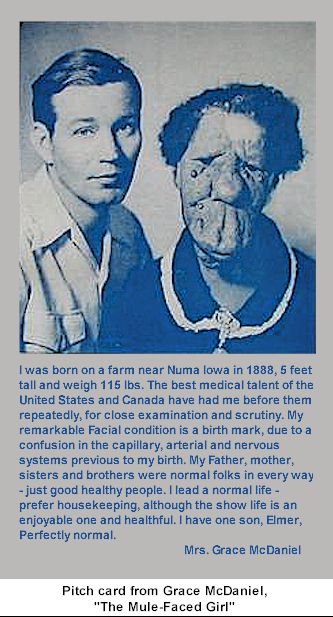
Pitch Cards — Cards containing photos and biographical information, sold for extra income by human oddities in a ten-in-one. The example pictured here was sold by Grace McDaniel, "The Mule-Faced Girl." She was a famous human oddity, much in demand for her genuinely freakish appearance as well as her intelligence and professionalism. From a "Fat Lady" on the Strates Show in 1941: "I know you folks in here would like to see me walking around. And while I'm walking around I have a few little souvenirs that I'll pass out to the men and the men only. Something you boys can have fun with and you'll get more laughs out of than anything you've ever seen before. You can show them to the girlfriends or the wives, it's perfectly alright. Now as I said before I pass them out to the men and the men only for 10¢ each. If you'd like to have one now I'm going to start on one end of the show and pass them around here just one time."
Plant or Power Plant — Generator.
Plant Show — A minstrel show or "plantation show".
Plaster — Cheap prizes made of plaster that appear more valuable than they are, currently used today to denote any cheap prize (although "slum" is a more common term). In collector's circles, "chalkware."
Platform — The raised stage where acts perform. It can refer to platforms inside the show or the bally platform on the front of the show.
Playing a Mark — Stringing along a player at your joint to get the most you can get of his money.
Plush — Stuffed animals or other stuffed figures used as prizes (the term is in common use today in the toy industry). Crane machines use crane stock (the small plush that fits in the bear claw and crane machines), other games use crazy ball stock (about a 16" piece of plush.) Referred to by their cost: $2, $4, $6, $8, $10, $12 and $24 pieces of plush.
Points — Similar to usage in real-estate: an extra fee, figured as a percentage of the gross, paid (in addition to footage charges and the various dings) to the owner, who usually splits it with the concession manager.
Poke — A carny's or mark's "stash" of money. It might be big, after a really good stand, or empty after a poor week or large expenses. In medieval times, a 'poke' was a pouch or bag (hence the expression 'buying a pig in a poke').
Popeye — A "working freak" who could literally make his eyeballs bulge out of their sockets.
Popper — Popcorn wagon, usually also selling floss and candy apples, sometimes drinks.
Posing Show — A girl show (ostensibly "artistic" and "educational" to get around objections on the grounds of nudity) in which female 'models' pose nude in imitation of famous works of art. The 1939 New York World's Fair had a posing show called "Jack Sheridan's Living Magazine Covers," in which bare-breasted models posed in depictions of magazine illustrations. (See inside this show and others on video here). Fredric Brown, in his novel The Dead Ringer, had something revealing to say: "if you’re a carney you stay out of the posing show. The models don’t mind posing in practically nothing at all for the marks, the suckers. They don’t count; they’re outsiders; you might almost say they aren’t human beings. It’s strictly impersonal. But it would be indecent for someone who knows them to go in and watch. It’d be as much Peeping Tom stuff as looking in trailer windows or over hotel-room transoms."
Possum Belly — Storage box built into the underside of a work wagon to carry cable, stakes, rigging, etc. At times a place for a quick nap by a worker, and at times the temporary home of an unauthorized "traveling girlfriend" (a "possum belly queen"). Why do these girls leave the crowd of locals in their hometowns? For the most part, the key word is "leave." A few nights of sex with a carny (who's probably no worse than the local high-school dropouts who've been trying to get her) might just be her ticket out of wherever she grew up.
Poster Joint — Any game in which the prize is a flashy (but really quite inexpensive) poster.
Prat Boy — (British) Crude term for a paid hand who does odd jobs for the joints like cleaning and cutting vegetables, getting stock from the trailer, cleaning up, etc. "Prat" in British usage meant "rump" (as in "pratfall", a comic fall on the butt). Runaways or kids yet too young to work a joint or make a pitch usually took the role. Different (but not much) from "green help," they may not be new workers but they are not skilled workers, and are not likely to become skilled workers.
Privilege — Rent paid to operate any joint, ride, show or concession. Often a percentage of the gross.
Professor — Title often assumed by any showman who wished to appear to be an "expert" who might demonstrate, in the name of education, exhibits or acts that might be open to objections under the simple guise of entertainment.
Proposition — The business deal offered to an independent to book with a certain carnival. If there's no "hole" (q.v.) for your type of joint, you might not get a proposition at all; if the owner needs something good on the "back end" to attract customers past all the joints, and you've got something like a girl show that he needs, the proposition might be very favorable.
Punch and Judy — A traditional children's puppet show, unchanged in form and content for centuries, more familiar in its original form in Britain. The standard plot pits the shrill, violent Punch against his shrewish wife Judy, with an array of beatings and murder that would be wholly unacceptable to many modern adult sensibilities. In America the term might refer to any puppet show, in ignorance of its origin. The show often appeared in old-time sideshows as entertainment for the children while their parents viewed stronger attractions. The "swazzle," the in-mouth whistle used to create the Punch puppet's voice, was sometimes sold as a pitch item. My e-book "ON THE MIDWAY" has an extensive list of punchman's lingo and history.
Punchboard — A thick rectangular board made of many layers of cardboard, generally about 8"x12" and about 1" thick. The top layer is a sheet of paper with a colorful design that includes a gambling layout, covering many holes each filled with a folded slip of paper. The customer pays the stated price to punch out one slip using the supplied metal key (much like a sardine-can key), and the paper slip indicates a prize of cash or merchandise, or a loss. Players are attracted to play by the promise of a certain number of high-value winning slips in each board. The boards are now illegal in many states, but are still manufactured for surreptitious use by individuals, or as part of the "charitable gaming industry" catering to bingo halls and social clubs. Collectors prize antique examples. Other devices, called 'jar tickets', 'pull tabs' and 'window cards', are made for similar gambling game play.
Punk — A child. Also a stuffed animal on a 'knock 'em over' game. See also "Pickled Punk".
Punk Day — The promotion offering one day when children are admitted to the fair free.
Punk Joint — A game that appeals mostly to kids (usually a hanky pank).
Punk Ride — Kiddie ride.
Punk Robber — An agent who runs a joint with a rigged kiddie game (like 'duck pond' in its gaffed form), or a flat joint aimed at children.
"Put 'em on the send" — To extract every last dime a person has and encourage them to go home (or to the ATM) for more money. No fooling, often it actually works.
Put-n-Take — A rigged game played for money (escalating costs and money prizes are always signs you'll be taken, and badly). Played with a small top which has the letters “P” and “T” on its several flat sides. Players spin the top and if it shows a “P” when it stops, the player has to put more money into the pot of cash … if the letter is a “T,” the player takes the pot. The top is rigged mechanically to spin honestly or to land on the letter of the agent's choice.
"Putting them in the pigpen" — See "Bally". When the tip has been turned just a bit early and there's a crowd eager to buy tickets and enter, they may have to be delayed just a bit ("put in the pigpen") so they don't enter too soon and interrupt the blowoff being conducted inside. Jammed together at the ticket box, no one is likely to push away through the crowd to leave.
Continue to Carnival Slang pages: A - C D - I J - P Q - Z
American Circus Slang British/Euro Circus Slang Vaudeville Slang
Ciazarn & The Carny Code Gypsies Slang Main Index Website Top Page